
Setology
A few hours before heading to Leeds to see Korn, I found myself doing what I suspect thousands of concert-goers do every weekend: trying to find out what songs the band might actually play.
Would they play the old favourites? How much of the setlist would be newer material? Would that song I've been listening to for the best part of thirty years make an appearance, or would I spend the evening waiting for something that was never going to happen?
And, while I was at it, what time were they actually coming on stage?
You'd think that information would be fairly easy to find in 2026.
Well, some of it was. Just not necessarily in one place.
Ticketmaster could tell me who was playing and where. Setlist.fm had a fascinating collection of previous performances. Various fan forums offered predictions, speculation and the occasional argument about which album was the band's last decent one.
What I wanted was something that brought all that information together and gave me a reasonably informed idea of what to expect.
So, naturally, instead of just looking up a few recent setlists and getting ready for the gig like a normal person, I decided to build a website.
Introducing Setology
Setology (noun)
/sɛtˈɒlədʒi/
The science of predicting what musicians will play, when they'll appear on stage and whether they'll actually perform that song you've been waiting twenty years to hear.
Setology (opens in a new tab) is my latest little project, created to answer the questions I was asking before that Korn concert.
At its heart is a simple idea: if you know what a band has been playing recently, you've got a pretty good chance of predicting what they'll play next.
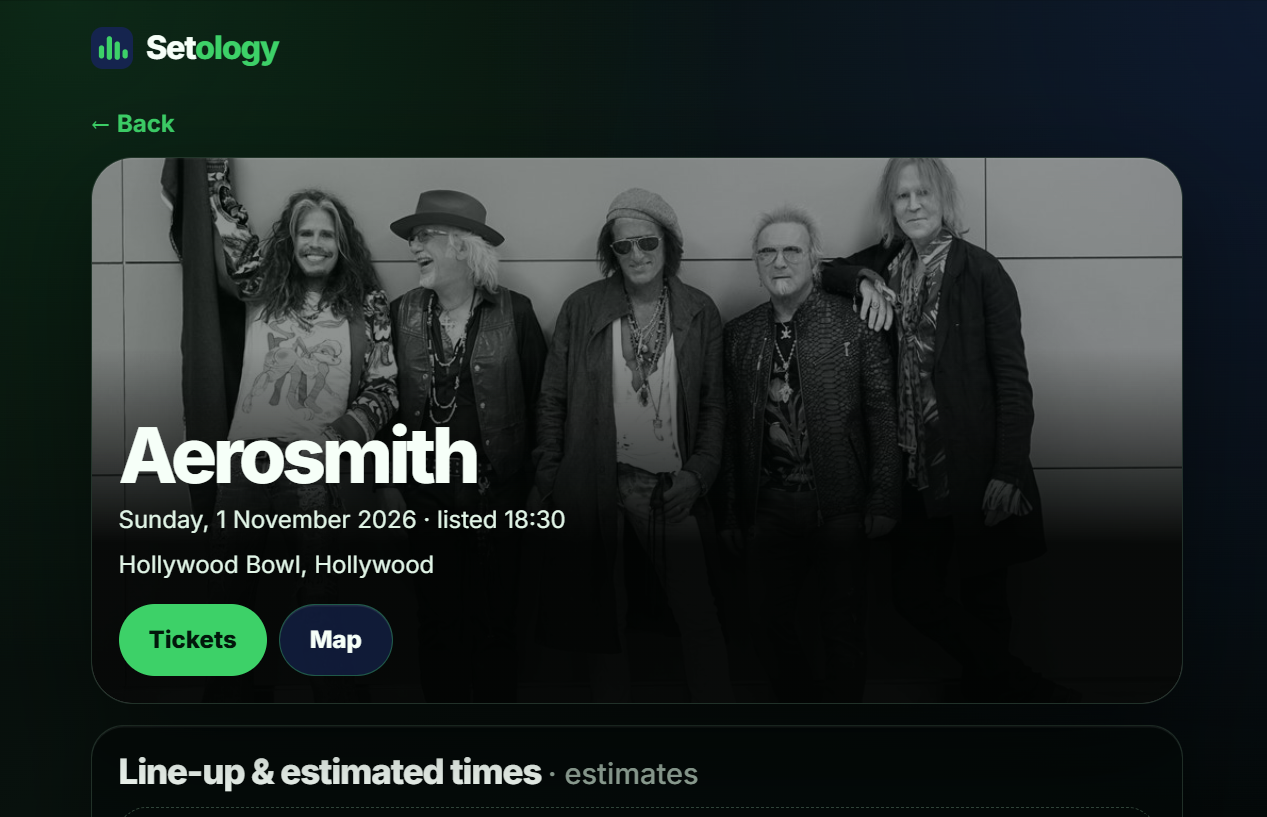
Setology helps you discover upcoming concerts, find out who's performing and, most importantly, see a predicted setlist based on the artist's recent live performances.
Here's what it does:
- Find gigs near you. Search upcoming concerts and discover who's playing.
- Predict the setlist. See which songs an artist is likely to perform, based on what they've played recently, particularly on the same tour.
- Explore the line-up. Find out which artists are appearing, including support acts where that information is available.
- Estimate stage times. Get an idea of when the bands might appear, rather than relying on the largely unhelpful time printed on your ticket.
Whether you're the sort of person who wants to know every song in advance, or you just want to check if your favourite has a fighting chance of making the cut, that's what Setology is designed to help with.
Of course, some people consider looking at a setlist before a concert to be the musical equivalent of reading the last page of a murder mystery.
Fair enough. Nobody's forcing you.
Predicting the Unpredictable
Setology uses data from Ticketmaster and Setlist.fm to piece together what might happen at an upcoming concert.
Ticketmaster provides information about events, venues and performers. Setlist.fm provides the really interesting stuff: a huge historical collection of songs that artists have played at their concerts.
And that's where things get interesting.
Bands can be surprisingly predictable creatures.
Some artists perform almost exactly the same show every night. The same songs, in the same order, with the same encore and probably the same carefully rehearsed moment when the singer pretends they've only just decided to play one more.
Others change things around constantly, throwing in different songs, unexpected covers and obscure album tracks that leave half the audience delighted and the other half wondering what's going on.
By examining recent performances, particularly those on the same tour, Setology can build a likely setlist for an upcoming show.
If a band has played a particular song at their last fifteen concerts, there's a reasonable chance you'll hear it at the sixteenth.
If they haven't played it since 1998, you might want to manage your expectations.
Naturally, none of this is guaranteed. A predicted setlist is exactly that: a prediction. Musicians have an irritating habit of being human and occasionally doing something unexpected.
But that's part of the fun.
And What Time Are They Coming On?
While setlist predictions were the main inspiration, I also wanted to answer another perennial concert-going question: when does the actual music start?
Not when the doors open. Not when the venue starts charging £8 for a pint. When does the band come on stage?
This is proving to be the trickier part of the project.
Although Setlist.fm holds an enormous amount of historical concert information, its API doesn't provide the actual stage times. That means I can't simply look up when a band started its previous shows and confidently predict the next one.
For now, stage times are estimates, and improving their reliability is very much a work in progress.
The ambition is to develop more confident predictions using historical information about venues, running orders, support acts and previous performances.
I'd rather Setology acknowledged what it doesn't know than confidently gave you the wrong answer.
There's already quite enough of that on the internet.
Another Problem That Didn't Need Solving
What I particularly like about Setology is how it came about.
There was no business plan, market research or carefully considered development roadmap.
I was going to a concert. I wanted some information. I couldn't find it presented quite how I wanted.
So I built something.
It's becoming a recurring theme with my projects. Sometimes an idea takes months to develop. Sometimes it takes shape in the few hours between deciding I want something and realising I could probably create it myself.
Setology falls firmly into the second category.
And, inevitably, what started as a quick solution to one small problem has become something with considerably more possibilities.
There's plenty I'd like to add, particularly around making the predictions more intelligent, identifying how frequently songs appear in an artist's recent performances and improving the stage-time estimates.
Whether I get around to all of that before discovering another problem that doesn't really need solving remains to be seen.
Give It a Go
Setology is live, free to use and still evolving.
If you've got a gig coming up, give it a try. Find your concert, explore the line-up and see what the band might have planned for you.
You might discover that your favourite song has been played at every show on the tour.
You might discover that it hasn't been played for twenty years.
Either way, at least you'll know whether to get your hopes up.
And if you find it useful, or have ideas for making it better, I'd love to hear them.
After all, the whole thing exists because I wanted to know what Korn were going to play in Leeds.
Some people would have just waited to find out.